The Honest Answer About Wegovy, Ozempic, Zepbound, Mounjaro, and Long-Term Weight Control
GLP-1 drugs have changed the weight-loss conversation in America. For years, people were told, “Just eat less and move more,” as if obesity were nothing more than a character flaw with a fork attached.
Now we know better.
Medications such as semaglutide, sold under names like Ozempic and Wegovy, and tirzepatide, sold under names like Mounjaro and Zepbound, work on appetite, fullness, blood sugar signaling, and the body’s weight-regulation system. These medications can help many people lose a meaningful amount of weight. But there is one question almost everyone eventually asks:
Will I regain the weight if I stop taking GLP-1 drugs?
The honest answer is: many people do regain weight after stopping, often a significant amount.
That does not mean the medicine failed. It does not mean you failed. It means weight regulation is biological, stubborn, and long-term. Obesity is increasingly treated as a chronic condition, not a short vacation from willpower.
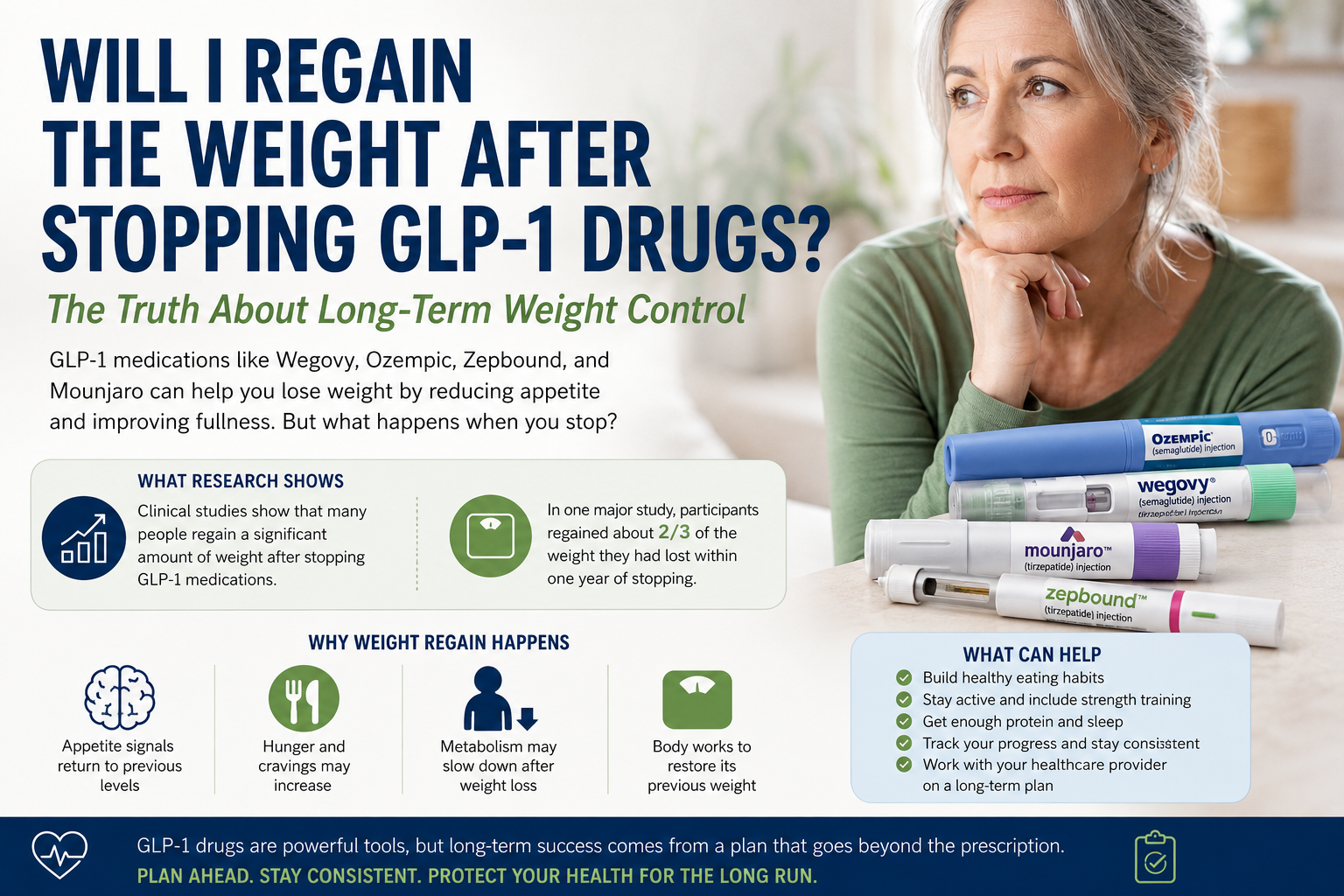
In the STEP 1 trial extension, people who had taken semaglutide regained about two-thirds of the weight they had lost within one year after stopping the medication. Their cardiometabolic improvements also moved back toward where they had been before treatment.
That is not a small detail. That is the headline.
The medicine can help you lose weight, but stopping the medicine often removes the very signal that helped your appetite and weight system stay under control.
Why Weight Comes Back After Stopping GLP-1 Drugs
To understand weight regain, we have to stop thinking about weight loss like a simple bank account.
Calories matter, yes. But the body is not a calculator sitting politely on your kitchen counter. The body fights change. When weight drops, the body often responds by increasing hunger, lowering energy expenditure, and pushing you back toward your previous weight.
This is sometimes called the body’s “set point,” although it is not quite as simple as a thermostat. It is more like an old furnace in the basement with a mind of its own.
GLP-1 medications help by changing appetite signals. Many people feel full sooner. Food noise decreases. Cravings may become easier to manage. Some people say it is the first time in their life they do not feel controlled by hunger.
When the medication stops, those benefits may fade. Appetite can return. Cravings can return. Portions can gradually creep up. The bathroom scale starts whispering bad news again.
And here is the part nobody wants to hear but everyone needs to know: weight regain after stopping is common enough that it should be planned for before stopping.
You do not wait until the boat is sinking to ask where the life jackets are.
What the Research Shows
The research is pretty clear: stopping GLP-1 treatment often leads to weight regain.
In the STEP 1 extension study, participants who stopped semaglutide regained a large portion of the weight they had lost. The study found that after treatment withdrawal, people regained 11.6 percentage points of lost weight, while the placebo group regained 1.9 percentage points. The authors concluded that ongoing treatment may be needed to maintain improvements in weight and health markers.
Tirzepatide tells a similar story. In the SURMOUNT-4 trial, people first used tirzepatide and lost substantial weight. Then some continued the medication while others were switched to placebo. Those who stopped tirzepatide regained weight, while those who continued treatment generally maintained or lost more weight.
A later analysis of SURMOUNT-4 also found that most adults who stopped tirzepatide after an initial 36 weeks regained weight.
The FDA-approved labeling for Wegovy describes it as a medication used to reduce excess body weight and maintain weight reduction long term, along with reduced-calorie eating and increased physical activity. That phrase matters: “maintain weight reduction long term.” This is not being framed as a quick 30-day tune-up.
The FDA also approved Zepbound for chronic weight management in adults with obesity or overweight with at least one weight-related condition, together with reduced-calorie diet and increased physical activity.
So the message is not “take the drug forever no matter what.” The message is more practical: do not treat this like a short-term diet unless your doctor has a clear maintenance plan.
Does Everyone Regain the Weight?
No. Not everyone regains all the weight. Some people maintain part of their weight loss after stopping. Some regain slowly. Some regain quickly. Some regain most or all of it.
Why the difference?
Several factors may matter:
Your age
Your starting weight
How much weight you lost
Your muscle mass
Your activity level
Your eating pattern
Your sleep
Your medications
Your medical conditions
Your stress level
Your support system
Whether you built habits while on the medication
Whether you stopped suddenly or with a plan
But even people with good habits can regain weight. This is where we have to be fair. A person can do many things right and still struggle after stopping.
The medication was not just “helping willpower.” It was affecting biology.
When that support is removed, the body may push back.
Why This Matters Especially in Elderhood
For people in Elderhood, this issue deserves extra care.
Weight loss after 60 or 70 is not the same as weight loss at 25. The goal should not be simply “get smaller.” The goal should be to protect strength, mobility, balance, independence, and metabolic health.
A bad weight-loss plan can cause muscle loss. And muscle loss in Elderhood is not cosmetic. It affects walking, climbing stairs, getting out of chairs, preventing falls, carrying groceries, and staying independent.
That is why anyone using GLP-1 drugs later in life should think about muscle preservation from the beginning.
The question is not only, “How much weight did I lose?”
The better question is:
What kind of weight did I lose?
If someone loses fat but also loses too much muscle, they may look thinner but feel weaker. That is not victory. That is trading one problem for another.
For older adults, the maintenance plan should include protein, resistance exercise, walking, balance, and regular medical monitoring. This is not about becoming a bodybuilder. Nobody is asking Grandpa to enter Mr. Olympia. But keeping muscle is one of the great survival tools of aging.
Why Stopping Can Feel So Discouraging
Many people feel ashamed when weight comes back. They think, “I blew it.” Or, “I knew I couldn’t keep it off.” Or, “I guess I have no discipline.”
That thinking is understandable, but it is not accurate.
If a blood pressure medication lowers your blood pressure, and your blood pressure rises after stopping it, we do not say, “You failed blood pressure.” We say the medication was helping control a chronic condition.
Weight regulation may work the same way for many people.
That does not mean lifestyle does not matter. Lifestyle matters enormously. But lifestyle may not fully replace the medication’s biological effect for everyone.
This is the adult conversation we need to have.
Not fantasy. Not shame. Not miracle talk.
Just reality.
Should GLP-1 Drugs Be Taken Forever?
This is the million-dollar question. Actually, with today’s drug prices, it may feel like the hundred-million-dollar question.
Some people may need long-term treatment to maintain the benefits. Others may stop because of side effects, cost, supply problems, insurance coverage, personal preference, or medical advice.
There is no one-size-fits-all answer.
But these drugs are generally being studied and approved in the context of chronic weight management, not quick cosmetic weight loss. Wegovy’s labeling specifically refers to reducing excess body weight and maintaining weight reduction long term.
That does not automatically mean everyone must stay on them forever. It means the decision to stop should be thoughtful.
Before stopping, ask your doctor:
What is my maintenance plan?
Should I reduce the dose gradually?
What should I watch for?
How often should I check weight, blood sugar, or blood pressure?
How do we protect muscle?
What happens if hunger returns strongly?
Are there lower-dose options?
Are there alternative medications?
What if insurance stops covering it?
Stopping without a plan is like canceling your home insurance because the house has not burned down lately. Maybe you will be fine. Maybe not. But it deserves more thought than a shrug.
What Happens to Hunger After Stopping?
Many people report that hunger comes back after stopping GLP-1 drugs. Food noise may return. Snacks may become more tempting. Portions may grow.
This can be especially frustrating because while taking the medication, eating less may have felt natural. After stopping, eating less may feel like dragging a sofa uphill.
That is why the transition period matters.
If hunger returns, it does not mean you are weak. It means the appetite system is waking back up.
A strong maintenance plan should focus on foods and habits that help fullness:
Protein at meals
High-fiber foods
Vegetables
Beans and lentils if tolerated
Greek yogurt or cottage cheese if appropriate
Eggs, fish, chicken, tofu, or other protein sources
Healthy fats in reasonable portions
Water and hydration
Regular meal timing
Less ultra-processed food
Fewer liquid calories
The boring basics matter. They are not glamorous, but they work better than pretending a celery stick will solve human biology.
The Muscle Issue: The Part People Ignore
When people lose weight quickly, they can lose both fat and lean mass. That is why strength training is important.
For older adults, this is critical. Muscle is not just for looking good at the beach. Muscle is glucose storage. Muscle is balance. Muscle is independence. Muscle is the difference between getting up from the floor and needing help.
If you are taking a GLP-1 drug or stopping one, talk with your doctor or a qualified professional about safe physical activity.
A good plan may include:
Walking most days
Light resistance bands
Chair squats
Wall pushups
Simple dumbbell exercises
Balance work
Protein with each meal
You do not need a fancy gym. You need consistency.
One of the best goals is simple: lose fat, keep strength.
What If You Stop Because of Cost?
This is becoming a major issue.
Many people stop GLP-1 drugs not because they want to, but because they cannot afford them or insurance stops covering them. That is where the system gets ugly. People may finally find something that works, only to have the price tag slam the door.
If cost is the reason for stopping, do not just disappear from care. Talk to your doctor. Ask about alternatives. Ask whether a lower dose is appropriate. Ask whether another medication, nutrition support, diabetes management plan, or structured lifestyle program may help.
Also ask your insurance plan specific questions. Do not accept vague answers like “not covered.” Ask:
Is it covered for diabetes?
Is it covered for obesity?
Is prior authorization required?
Are there step therapy rules?
Is there an appeal process?
Are there covered alternatives?
Will coverage change next year?
In Medicare, drug coverage can vary by plan and by year. Formularies change. Prior authorization rules change. Costs change. That means people should review their plan carefully during the appropriate enrollment period.
What If You Stop Because of Side Effects?
Some people stop because of nausea, vomiting, constipation, diarrhea, reflux, fatigue, or other side effects. Others may have more serious concerns.
Do not tough it out silently. Talk to your doctor. Sometimes side effects can be managed by adjusting the dose, slowing dose increases, changing eating habits, or reviewing other medications.
But some people truly cannot tolerate these drugs. That does not make them failures. It means their body said, “No thank you,” and sometimes the body gets the final vote.
If you stop because of side effects, ask for a maintenance plan immediately. The earlier you plan, the better chance you have of protecting the weight loss you achieved.
Can Lifestyle Alone Maintain the Weight Loss?
For some people, yes. For others, not fully.
Lifestyle is still essential. Medication without lifestyle is weaker than medication with lifestyle. But lifestyle is not magic either.
The best approach is to build habits while the medication is helping. Think of the medication as giving you a quieter room so you can learn new behaviors. While hunger and cravings are lower, that may be the best time to practice:
Smaller portions
Higher protein meals
Less snacking
More walking
Strength training
Better sleep
Meal planning
Tracking weight weekly
Reducing ultra-processed foods
Do not wait until after stopping to start building habits. That is like waiting until retirement to start saving money. Possible, but the hill is steeper.
Should You Weigh Yourself After Stopping?
Yes, but do it wisely.
Daily weighing can make some people anxious. Never weighing can allow 20 pounds to sneak back in wearing a fake mustache.
A reasonable middle ground is once a week. Same day. Same time. Same scale. For many people, Saturday morning works well because it gives you a steady checkpoint without turning every day into a courtroom drama.
If weight starts creeping up, do not panic. Respond early.
A five-pound regain is a warning light. A thirty-pound regain is a committee meeting.
Warning Signs That You Need Help
After stopping a GLP-1 drug, contact your doctor or care team if:
Your hunger returns intensely
You regain weight quickly
Your blood sugar rises
Your blood pressure worsens
You feel weak or lose muscle
You become dizzy or dehydrated
Constipation or digestive symptoms continue
You feel depressed or ashamed about weight regain
You are unsure how to restart or adjust treatment
This is not something to handle alone with internet guesses and kitchen-table guilt.
The Best Way to Stop: Make a Plan Before You Stop
Before stopping, create a written plan with your clinician.
That plan should include:
Your current weight and goal range
Your protein target
Your exercise plan
Your strength plan
Your follow-up schedule
Your medication options
Your warning signs
Your insurance review
Your plan if weight returns
The goal is not perfection. The goal is not panic. The goal is awareness.
Stopping a GLP-1 drug without a plan is where many people get blindsided.
The Bottom Line
Yes, many people regain weight after stopping GLP-1 drugs.
Research on semaglutide and tirzepatide shows that weight regain is common after withdrawal, and some health improvements can fade as weight returns.
But that does not mean the medicine failed. It means obesity and weight regulation are long-term biological issues. For many people, long-term treatment or a serious maintenance plan may be needed.
The best strategy is to think ahead:
Do not start without understanding maintenance.
Do not stop without a plan.
Protect muscle.
Build habits while appetite is controlled.
Track weight calmly.
Talk to your doctor early.
Review insurance and medication options carefully.
GLP-1 drugs can be powerful tools. But they are not magic wands. And they are not moral tests.
They are medical tools. Use them thoughtfully, monitor them carefully, and make sure the plan is not just about losing weight, but about staying strong, steady, and healthy for the long run.
Educational disclaimer: This article is for general educational purposes only and is not medical advice. GLP-1 medications can have risks, side effects, and contraindications. Do not start, stop, or change any medication without speaking with your healthcare provider.