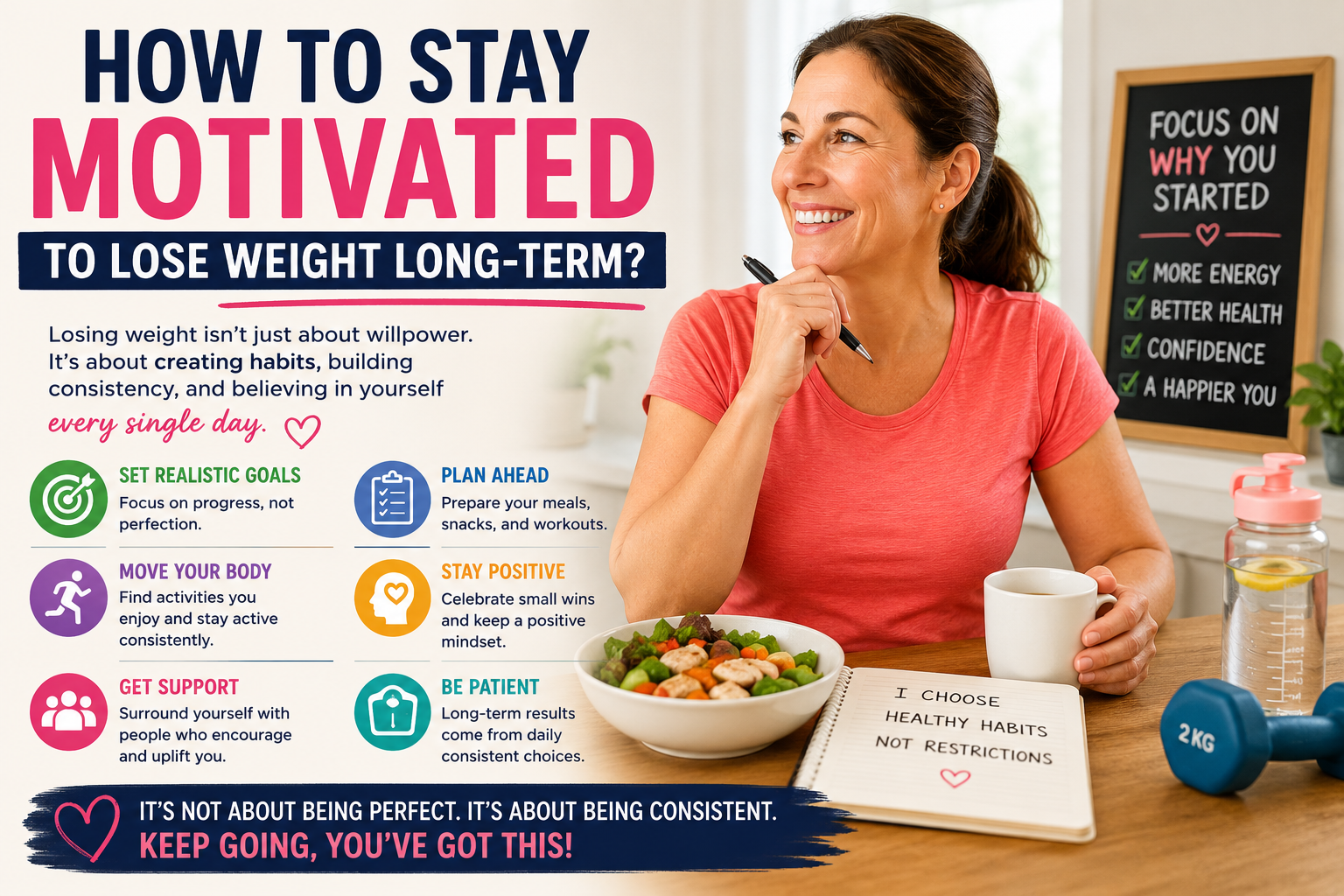
Losing weight is exciting in the beginning.
You buy the healthy groceries. You make promises to yourself. You imagine the new clothes, the better energy, the smaller number on the scale, and maybe even the doctor saying, “Whatever you’re doing, keep doing it.”
Then real life shows up.
The birthday cake appears. The scale stops moving. Your family orders pizza. Your knees complain. You have one bad day, then two, and suddenly the “new me” is arguing with the “old me” in front of the refrigerator at 9:30 at night.
That is why long-term weight loss is not just about food. It is about motivation, habits, patience, and learning how to keep going after the excitement wears off.
The truth is simple: anyone can be motivated for a week. The real victory is learning how to stay committed for months and years.
Motivation Is Helpful, But Habits Do the Heavy Lifting
Motivation is like a spark. It gets you started. But habits are the firewood that keep the fire going.
If you depend only on motivation, you will struggle because motivation changes from day to day. Some mornings you feel ready to conquer the world. Other mornings you feel like your walking shoes are personally insulting you from across the room.
That is normal.
The CDC explains that healthy weight loss is built around a lifestyle that includes healthy eating patterns, regular physical activity, enough sleep, and stress management. It also recommends making a specific plan instead of relying on vague wishes.
That is the big lesson: long-term weight loss works best when it becomes a lifestyle, not a temporary punishment.
At JoanBars.com, the goal should not be “starve yourself until the scale behaves.” The goal is to build a practical eating routine you can actually live with.
Because the best weight-loss plan is not the one that sounds impressive. It is the one you can still follow on a Tuesday when you are tired, busy, and not in the mood.
Stop Thinking Like You Are “On a Diet”
One of the biggest motivation killers is the phrase “I’m on a diet.”
Why?
Because if you are “on” a diet, that means one day you will be “off” the diet. And when people go off the diet, the old habits often come marching back like they never left.
A better mindset is this: “I am learning how to eat in a way that supports the life I want.”
That sounds less dramatic, but it works better.
Long-term weight loss is not about white-knuckling your way through hunger. It is about building a new normal. That means meals that satisfy you, snacks that help you stay on track, and enough flexibility that one imperfect meal does not turn into a week-long surrender.
Mayo Clinic says successful weight loss requires a long-term commitment to healthy lifestyle changes in eating, exercise, and behavior. It also recommends focusing on nutritious foods, moving more, tracking habits, and setting daily goals.
That is not glamorous. But it is true.
The “magic” is usually not magic. It is repetition.
Know Your Personal Why
If your only reason for losing weight is “I want the scale to be lower,” motivation may fade quickly.
A number can help you measure progress, but it is not always strong enough to carry you through hard days.
Ask yourself a deeper question:
Why do I really want to lose weight?
Maybe you want to walk without getting winded. Maybe you want to reduce pressure on your knees. Maybe you want to improve your blood sugar. Maybe you want to feel comfortable in your clothes. Maybe you want to travel, dance, garden, play with grandchildren, or simply get out of a chair without making that little noise we all pretend we do not make.
That “why” matters.
Write it down. Put it somewhere visible. Not as a guilt trip, but as a reminder.
You are not just trying to lose pounds. You are trying to gain energy, confidence, mobility, health, and freedom.
That is a much better bargain.
Make the Plan Smaller, Not Bigger
Many people fail because they try to change everything at once.
They go from no exercise to two hours a day. From fast food to kale sermons. From late-night snacks to “I shall never eat again after sunset.” It lasts about four days, and then the body files a formal complaint.
Do not build a plan that requires you to become a completely different person by Monday.
Start smaller.
Walk ten minutes after dinner. Add protein to breakfast. Drink water before snacking. Replace one high-calorie dessert with a planned healthier option. Prepare a simple meal ahead of time. Keep a sensible snack available so you are not ambushed by hunger.
The National Institute on Aging explains that balancing the calories you eat with physical activity is key to maintaining a healthy weight, and that healthy eating and exercise work together.
Small changes may not feel dramatic, but they are easier to repeat. And repeated actions are what change a life.
Think of it this way: nobody gets out of shape in one meal, and nobody gets healthy in one salad.
It is the pattern that wins.
Use the Scale, But Do Not Worship It
The scale can be useful. It can also be a troublemaker.
Weight naturally fluctuates because of water, salt, digestion, hormones, medications, inflammation, and even poor sleep. If you weigh yourself after one salty meal, the scale may act like you swallowed a bowling ball.
That does not mean you failed.
Harvard Health notes that people who monitor their weight regularly may detect small gains earlier and take action before the problem grows.
That makes sense. But the scale should be a tool, not a judge.
Look at trends over time, not one dramatic morning. Also pay attention to other victories:
Your clothes fit better.
You walk farther.
You sleep better.
You have fewer cravings.
You eat more controlled portions.
You recover faster.
You feel more in charge.
Those things count.
Sometimes the body improves before the scale gives you applause.
Build Meals That Control Hunger
Long-term motivation disappears fast when you are hungry all the time.
A plan that leaves you constantly starving is not a plan. It is a hostage situation.
To stay motivated, meals should help you feel satisfied. That usually means including protein, fiber, and healthy foods that take time to digest.
Protein can help preserve muscle during weight loss. Fiber from vegetables, fruit, beans, oats, and whole foods can help you feel fuller. Water helps too, especially because thirst is often mistaken for hunger.
This is where planned options can make a difference. A structured snack or meal replacement from JoanBars.com may help some people avoid the “I got too hungry and ate whatever was closest” problem.
That is not about perfection. It is about preparation.
The dangerous moment is not always when you are mildly hungry. It is when you are very hungry, tired, rushed, and standing near food that requires no preparation. That is when cookies start making speeches.
Exercise for Health, Not Just Calories
Exercise helps weight loss, but not always in the way people think.
Many people overestimate how many calories they burn. A walk is wonderful, but it does not automatically erase a giant muffin. That muffin has legal representation.
Still, exercise is essential for long-term success because it protects muscle, improves mood, supports heart health, improves sleep, helps blood sugar, and makes you feel capable.
Harvard Health states that regular exercise can help control appetite, boost mood, improve sleep, and reduce long-term risks of heart disease, stroke, diabetes, dementia, depression, and many cancers.
That is a pretty good return on investment.
Do not make exercise complicated. Start with walking, chair exercises, resistance bands, light weights, water exercise, or whatever your body can handle safely.
The goal is not to punish yourself for eating. The goal is to remind your body that it is still in business.
Plan for Plateaus
Almost everyone hits a plateau.
The scale moves at first, then slows down. This is where many people quit because they think the plan “stopped working.”
Not necessarily.
As you lose weight, your body may need fewer calories. Your metabolism adapts. Your habits may loosen. Portions may slowly creep up. Exercise may become routine and burn fewer calories than before.
A plateau is not failure. It is feedback.
When it happens, review the basics:
Are portions getting larger?
Are snacks sneaking back in?
Are weekends undoing weekdays?
Are you drinking calories?
Are you getting enough protein?
Are you moving less than you think?
Are you sleeping poorly?
Are you under stress?
Do not panic. Adjust.
Long-term weight loss is not a straight line. It is more like driving on a road with potholes, detours, and a few confusing signs. You do not abandon the car because you hit traffic.
Sleep and Stress Matter More Than People Think
Poor sleep and high stress can make weight loss harder.
When you are tired, cravings often increase. Discipline drops. Movement feels harder. Late-night snacking becomes more tempting. Stress can push people toward comfort foods, especially foods high in sugar, fat, and calories.
Harvard Health explains that stress can lead people to overeat, lose sleep, exercise less, and drink more alcohol, all of which can contribute to weight gain.
The CDC also lists sleep and stress management as part of a healthy lifestyle for weight control.
So if you are struggling with motivation, do not only ask, “What am I eating?”
Also ask:
Am I sleeping enough?
Am I overwhelmed?
Am I using food to calm myself down?
Am I eating because I am hungry, or because I am tired?
Food is often the symptom. Life is sometimes the cause.
Do Not Let One Bad Day Become a Bad Month
This may be the most important rule.
You will have imperfect days.
You will overeat sometimes. You will skip exercise. You will eat dessert. You will go on vacation. You will attend family events where someone says, “Just have a little,” while handing you enough food for three counties.
That is life.
The mistake is not one bad meal. The mistake is turning one bad meal into a bad week because you feel guilty.
One flat tire does not mean you slash the other three.
When you slip, get back to your routine at the next meal. Not Monday. Not next month. Not after the holidays.
The next meal.
Long-term success belongs to people who recover quickly.
Use Support and Accountability
Weight loss can feel lonely if you are doing it silently.
Support helps.
That may mean a spouse, friend, online group, coach, doctor, dietitian, or structured program. It may also mean simply telling someone, “I am working on my health, and I could use encouragement.”
Accountability is not about shame. It is about staying aware.
You can track meals, steps, water, weight, waist measurement, or weekly goals. Choose what helps you, not what makes you miserable.
Some people love tracking. Others feel trapped by it. The best system is the one you can use consistently.
At JoanBars.com, readers can be encouraged to think of weight loss as a guided routine, not a private battle fought alone in the kitchen.
Make Your Environment Work for You
Willpower is overrated.
Environment matters.
If your kitchen is full of tempting foods, you will need willpower all day long. That is exhausting. Better to design your surroundings so the healthy choice is easier.
Keep simple healthy foods visible. Keep trigger foods out of easy reach. Prepare snacks in advance. Have water nearby. Put walking shoes where you can see them. Keep your meal plan simple.
You are not weak because food temptations work on you. Food companies spend billions making sure they do.
So stop trying to win every battle by strength alone. Change the battlefield.
Celebrate Non-Food Rewards
Many people reward weight loss with food. That can backfire.
Instead, celebrate progress with things that support your new identity.
Buy a new walking shirt. Get better shoes. Take a photo. Plan a day trip. Enjoy a massage. Download an audiobook for walks. Share your progress with someone who will cheer for you.
Reward the behavior, not just the scale.
Celebrate consistency. Celebrate cooking at home. Celebrate walking three days this week. Celebrate stopping when full. Celebrate drinking water instead of soda. Celebrate getting back on track after a difficult day.
These victories are not small. They are the foundation.
Think Maintenance From the Beginning
Many people focus only on losing weight. But keeping it off requires a second plan.
Ask yourself early:
Can I eat this way long-term?
Can I afford this plan?
Do I enjoy some of the food?
Does this fit my family life?
Can I travel with this routine?
What will I do after I reach my goal?
Mayo Clinic emphasizes that the best way to lose weight and keep it off is to make lasting lifestyle changes, including balanced eating and more daily movement.
That is the part many quick diets ignore.
They help you lose weight, but they do not teach you how to live afterward.
The real goal is not just weight loss. The real goal is weight control.
That means building a routine you can keep, adjust, and return to when life gets messy.
The Bottom Line
Staying motivated to lose weight long-term is not about being perfect.
It is about building habits that survive real life.
You need a clear reason, a simple plan, satisfying meals, regular movement, better sleep, stress awareness, support, and the ability to recover from mistakes without quitting.
Motivation may get you started, but consistency carries you forward.
Do not chase extreme diets. Do not punish yourself. Do not let one bad day erase your progress.
Instead, build a routine that says: this is how I take care of myself now.
That is the real secret.
Not magic. Not misery. Not another quick fix.
Just small smart choices, repeated long enough to change the direction of your health.
For more practical weight-loss support, meal ideas, and simple tools to stay on track, visit JoanBars.com and start building a plan you can actually live with.