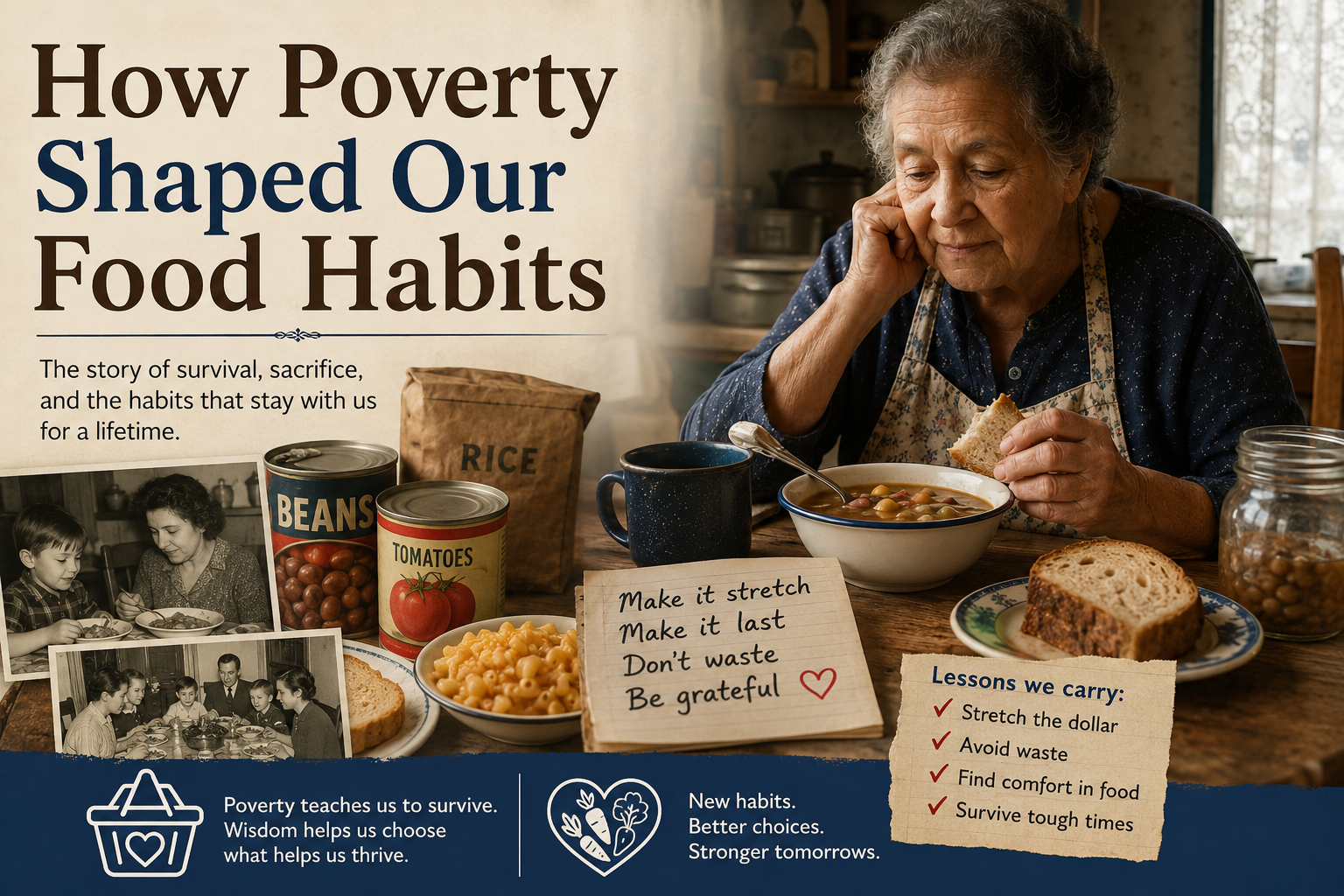
Food habits are not created in a vacuum.
They are shaped by money, time, culture, stress, transportation, advertising, family history, and survival. For many families, especially older adults who grew up during leaner times, food was never just about nutrition. Food was about making it to the end of the week.
That is the honest starting point.
When we talk about poor eating habits, we have to be careful not to turn it into a lecture. Too often, people say, “Just eat healthier,” as if everyone has a private chef, a garden, a relaxed schedule, and a grocery budget with room to breathe.
Real life is different.
Poverty teaches people to stretch food. It teaches people to choose what fills the belly. It teaches people to buy what lasts, what is cheap, what children will eat, and what does not spoil before payday. Over time, those survival choices can become family traditions, emotional comforts, and everyday habits.
The problem is that the foods that help people survive poverty are often not the foods that help the body thrive over a lifetime.
That is not a moral failure.
That is a reality we need to understand.
Poverty Changes the Food Question
When money is tight, the question is not always, “What is the healthiest thing I can eat?”
The question becomes:
“What can I afford?”
“What will fill me up?”
“What will last until next week?”
“What can I cook quickly?”
“What can I buy without a car?”
“What will my family actually eat?”
That is a very different food conversation.
Fresh fish, berries, nuts, lean meats, high-quality olive oil, and fresh vegetables may sound wonderful. But if someone is living on a fixed income, feeding grandchildren, paying rent, buying medication, and watching grocery prices climb like they are training for the Olympics, those foods may feel out of reach.
According to USDA Economic Research Service data, 13.7 percent of U.S. households were food insecure in 2024, meaning they had limited or uncertain access to enough food during the year. Very low food security means eating patterns were disrupted and food intake was reduced at times because there was not enough money or resources for food.
That matters because food insecurity does not just affect how much people eat. It affects what people eat.
Cheap Calories Became the Survival Strategy
Poverty often pushes families toward cheap calories.
Not because people are foolish.
Because cheap calories work in the short term.
White bread. Rice. Pasta. Potatoes. Packaged noodles. Sugary cereals. Hot dogs. Canned foods. Frozen meals. Crackers. Cookies. Snack cakes. Soda. Sweet tea.
These foods are usually affordable, available, filling, and familiar. Many are shelf-stable. Many require little cooking. Many can feed a family fast.
That is why they become staples.
But here is the cruel trick: the foods that are cheapest per calorie are often not the richest in nutrients.
A dollar can buy a lot of refined starch. It does not buy much salmon.
This is one reason poverty and poor diet quality become linked. A review of nutrition policy and food insecurity found that food insecurity is consistently associated with poorer diet quality and higher risks of cardiometabolic disease, obesity, and mental health concerns across the life course.
That is the poverty trap in food form.
The body gets calories, but not always the building blocks it needs.
The “Clean Your Plate” Generation
Many people in Elderhood grew up hearing:
“Don’t waste food.”
“Clean your plate.”
“There are children starving.”
“You eat what is served.”
“Leftovers are for tomorrow.”
These lessons came from real hardship. Parents and grandparents who lived through the Great Depression, war rationing, migration, farm labor, unemployment, or low wages were not being dramatic. They knew what scarcity felt like.
Food waste was almost a sin.
That lesson had value. It taught gratitude, discipline, and respect for resources.
But it also created habits that can become difficult later in life.
Some people still feel guilty leaving food on a plate, even when they are full. Some keep eating because food is there. Some buy too much when something is on sale because the old fear of “not enough” still whispers in the background.
Poverty does not just live in the wallet.
Sometimes it lives in the nervous system.
Even when life improves, the survival habits remain.
Processed Food Promised Convenience
As America modernized, processed food became more than cheap. It became marketed as progress.
Canned soup. TV dinners. Boxed macaroni. Instant potatoes. Powdered drinks. Breakfast cereal. Cake mixes. Frozen pizza.
These foods promised convenience, modernity, and relief.
For working families, especially mothers who were expected to feed everyone after a long day, convenience food was not laziness. It was survival with a label on it.
The food industry understood this very well.
They did not sell only food.
They sold ease.
They sold “ready in minutes.”
They sold “kids love it.”
They sold “just add water.”
They sold a way to get dinner on the table when everyone was tired and money was tight.
The result is that many families developed deep emotional attachments to processed foods. These were the foods of childhood, comfort, family gatherings, late-night meals, church basements, school lunches, and busy weeknights.
So when someone says, “Just stop eating processed food,” they are not only asking a person to change ingredients.
They are asking them to change memory.
That is not simple.
Food Deserts and Food Swamps
Poverty also shapes food habits through access.
Some communities do not have nearby supermarkets with affordable fresh food. Others have plenty of food available, but most of it is fast food, convenience-store food, dollar-store food, and highly processed packaged food.
The USDA Food Access Research Atlas tracks low-income and low-access census tracts and includes measures such as distance to supermarkets and vehicle access.
That tells us something important: food choices are partly shaped by geography.
If the nearest place to buy food is a gas station, a dollar store, or a fast-food counter, then telling people to “shop the perimeter of the grocery store” sounds a little ridiculous. First, they need a grocery store.
And if someone does not drive anymore, or cannot afford gas, or has mobility issues, the food environment becomes even more important.
In Elderhood, this can become a major issue.
A person may know what healthy food is. But can they get it? Can they carry it? Can they cook it? Can they afford it? Can they chew it? Can they store it?
Those are the real questions.
Ultra-Processed Foods Became Normal
Ultra-processed foods are now a major part of the American diet. A CDC report using data from August 2021 through August 2023 found that ultra-processed foods made up about 55 percent of total calorie intake in the United States, with even higher intake among children and teens.
That means this is not a fringe problem.
It is the mainstream food environment.
Ultra-processed foods are often designed to be cheap, tasty, convenient, and hard to stop eating. They may combine refined carbohydrates, fats, salt, sugars, flavorings, and additives in ways that make them extremely appealing.
Again, this is not about blaming the individual.
If a food is cheap, everywhere, heavily advertised, shelf-stable, and engineered to taste good, it is going to win a lot of battles.
Especially when people are tired, stressed, lonely, rushed, or broke.
A 2022 study found that ultra-processed food intake was higher among adults with very low food security than among those with high food security.
That is what poverty does. It does not just limit choice. It pushes people toward the most available and affordable choices, even when those choices may harm long-term health.
The Emotional Side of Poverty Eating
Food is emotional.
When life is hard, food can become comfort, reward, celebration, escape, and memory.
A sweet snack may be the only affordable treat.
A fast-food meal may be the only moment of relief after a stressful day.
A big plate of rice, pasta, or potatoes may feel like safety.
A soda may feel like a small luxury.
People with money have expensive comforts too. They just call them “experiences.”
Poor people’s comforts are often judged more harshly.
That is unfair.
But we also have to be honest: emotional eating built around cheap, processed foods can become a health burden over time.
Especially in Elderhood, when the body may need more protein, fiber, micronutrients, hydration, and steady blood sugar support.
The old poverty diet may have kept people going.
But it may not be enough to keep the aging body strong.
Poverty Taught Us to Prioritize Fullness Over Nutrition
One of the deepest food habits poverty creates is the idea that “full” means “fed.”
But full and nourished are not the same thing.
A person can be full from white bread, soda, chips, and noodles while still not getting enough protein, fiber, minerals, or vitamins.
This becomes especially important as we age.
Older adults may need to pay closer attention to:
Protein for muscle preservation.
Fiber for digestion and gut health.
Calcium and vitamin D for bone health.
B vitamins for energy and nerve function.
Omega-3 fats for heart and brain support.
Hydration for kidney function, blood pressure, and mental clarity.
The poverty food mindset says, “Did you eat?”
The Elderhood food mindset asks, “Did your body get what it needs?”
That is a major shift.
The Fixed-Income Food Problem
Many older adults today are living with a modern version of the old poverty problem.
They may not consider themselves poor, but they are financially squeezed.
Rent is higher.
Utilities are higher.
Insurance costs are higher.
Medication costs can be unpredictable.
Dental care is expensive.
Groceries feel like they have joined a luxury club.
On a fixed income, food becomes one of the few flexible categories. You cannot always lower the rent. You cannot negotiate with the electric bill. But you can buy cheaper food.
That is where nutrition quietly gets sacrificed.
The USDA has reported that food-secure households acquired more fruit, whole fruit, total protein, and seafood and plant proteins than food-insecure households.
That matters because the foods that often get cut first are the foods the aging body may need most.
Protein.
Produce.
Fish.
Nuts.
Fresh foods.
The grocery cart tells the story.
How to Break the Poverty Food Pattern Without Shame
The goal is not to insult the foods that helped families survive.
The goal is to upgrade the pattern.
Not overnight.
Not with a $200 grocery haul full of things nobody knows how to cook.
Start with small, practical substitutions.
Add protein to breakfast.
Choose plain oatmeal instead of sugary cereal.
Add beans to soup.
Buy canned sardines, tuna, salmon, or chicken when fresh meat is too expensive.
Use frozen vegetables, which are often cheaper and last longer.
Choose Greek yogurt or cottage cheese for affordable protein.
Add eggs if they fit your budget.
Drink water before soda.
Use fruit as dessert more often.
Buy store brands.
Cook once, eat twice.
Keep a simple “survival shelf” with healthier staples: beans, lentils, canned fish, oats, peanut butter, brown rice, canned tomatoes, frozen vegetables, and low-sodium soups.
This is not glamorous.
But glamorous does not build health.
Consistency does.
Reframing Food in Elderhood
In younger years, food may have been about survival, pleasure, family, and convenience.
In Elderhood, food becomes structure.
Food helps preserve muscle.
Food supports the brain.
Food influences energy.
Food affects digestion.
Food may influence inflammation, blood sugar, blood pressure, and resilience.
That does not mean every meal has to be perfect. Nobody needs to live like a monk unless the monk is also making meatloaf.
The goal is to eat in a way that helps you stay alive in your own life.
That means asking better questions:
Does this meal help my strength?
Does it include protein?
Does it include fiber?
Will it keep me steady or make me crash?
Is this food helping my future self?
Those questions are more useful than guilt.
The Real Lesson
Poverty shaped our food habits by teaching us to survive.
It taught us to stretch meals, avoid waste, seek cheap calories, trust shelf-stable foods, and find comfort in what was available.
Those habits deserve understanding.
But understanding is not the same as staying trapped.
We can honor the past without letting it control the future.
We can say, “This is how my family survived,” and also say, “Now my body needs something more.”
That is not betrayal.
That is wisdom.
Because the body changes. The world changes. Food changes. And in Elderhood, we have the right to rethink what we were taught.
Not with shame.
Not with arrogance.
Not with fancy nonsense.
With practical intelligence.
A can of sardines.
A bowl of beans.
A boiled egg.
A bag of frozen vegetables.
A glass of water.
A walk after dinner.
Simple things.
The kind of things poverty may have hidden from us, but wisdom can bring back.
Final Thought
Poverty did not just shape what we ate.
It shaped how we thought about food.
It taught many people to chase fullness, avoid waste, stretch the dollar, and accept whatever was available.
Now the task is different.
In Elderhood, the question is no longer only, “How do I get enough food?”
The question becomes, “How do I feed the body I still need to live in?”
That is the shift.
From survival eating to strength eating.
From cheap calories to useful nourishment.
From guilt to awareness.
From old patterns to better choices.
Not perfect choices.
Better choices.
And sometimes, better is exactly enough.
Educational disclaimer: This article is for educational purposes only and is not medical, nutritional, or financial advice. Always consult a qualified healthcare professional, registered dietitian, or appropriate advisor regarding your personal health, diet, and financial situation.