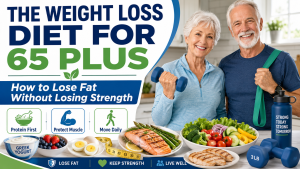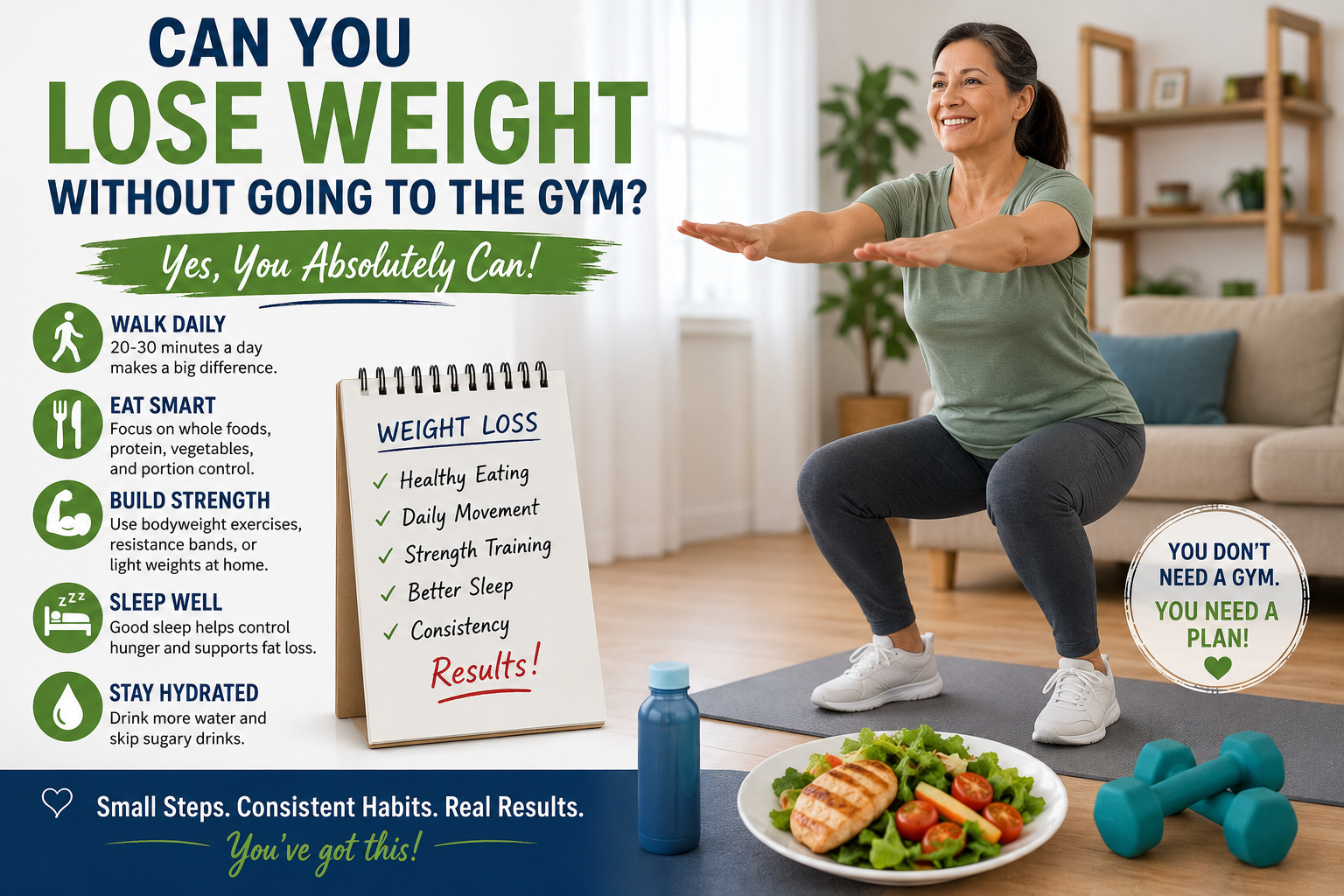
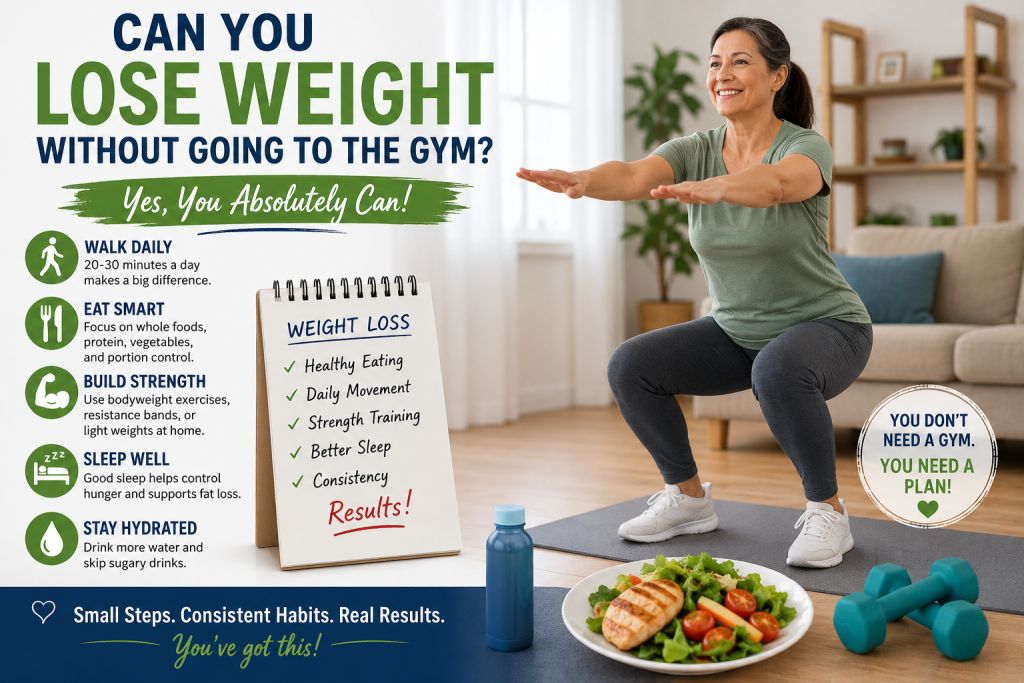
Yes, you can lose weight without going to the gym.
Let’s get that out of the way first.
The gym can help. It gives you equipment, structure, and a place where everyone is sweating on purpose. But the gym is not the magic ingredient. Plenty of people pay for a gym membership, walk past the treadmill, wave at the weights, and then reward themselves with a muffin the size of a throw pillow.
Weight loss does not happen because you own sneakers.
Weight loss happens when your body consistently uses more energy than you take in. That does not require a gym. It requires better food choices, more daily movement, enough protein, better habits, and some form of strength-building activity.
For older adults especially, the goal should not simply be “lose weight.” The better goal is:
Lose fat while protecting muscle.
That is the part many people miss.
Because when someone says, “I lost 10 pounds,” the real question is:
Ten pounds of what?
Did you lose fat?
Did you lose water?
Or did you lose muscle?
That question matters more as we age. Muscle is not just for bodybuilders walking around like overstuffed luggage. Muscle helps you get out of a chair, carry groceries, climb stairs, keep your balance, protect your bones, and stay independent.
So yes, you can lose weight without the gym. But you still need a smart plan.
Weight Loss Starts With Food, Not a Gym Membership
There is an old saying: you cannot out-exercise a bad diet.
It is not perfect, but it is mostly true.
You can walk for 30 minutes and burn a modest number of calories, then wipe out the whole benefit with a sweet coffee drink, a handful of cookies, or a “healthy” snack bar that is really a candy bar wearing a yoga outfit.
The Mayo Clinic explains that cutting about 500 calories a day from your usual diet may lead to about ½ to 1 pound of weight loss per week, though results vary by person, activity level, body size, and other factors. Mayo also notes that weight loss often includes a mix of fat, lean tissue, and water — which is why protecting muscle matters.
That does not mean you have to count every calorie like you are doing federal accounting.
But it does mean you need awareness.
Most people do not gain weight from one big mistake. They gain weight from small daily habits repeated for years.
A little too much bread.
A little too much soda.
A little too much late-night snacking.
A little too much “I deserve this.”
And listen, sometimes you do deserve it. But your waistline does not care about your emotional argument. The body keeps receipts.
The Gym Is Optional. Movement Is Not.
You do not need a gym, but you do need movement.
The CDC recommends that adults get at least 150 minutes a week of moderate-intensity aerobic activity, which could be brisk walking for about 30 minutes a day, five days a week. The CDC also recommends muscle-strengthening activity at least two days per week.
For older adults, the CDC gives similar guidance: brisk walking for 150 minutes per week, muscle-strengthening activities at least two days per week, and balance activities as part of a healthy routine.
Notice something important: it does not say you must go to a gym.
Walking counts.
Dancing counts.
Gardening counts.
Taking the stairs counts.
Cleaning the house counts.
Carrying groceries counts.
Doing chair exercises counts.
The Mayo Clinic makes a useful distinction: physical activity includes everyday movement such as cleaning, shopping, gardening, and making the bed, while exercise is more structured and repeated. Both matter.
So if you hate the gym, fine. Do not go.
But do not use that as an excuse to become furniture.
Walking Is the Most Underrated Weight Loss Tool
Walking is simple, free, low-risk, and available almost everywhere.
You do not need special machines. You do not need tight clothing. You do not need to understand what a “burpee” is, which frankly sounds like something a baby does after lunch.
Walking after meals can be especially useful because it helps you move when your body is processing food. Even 10 to 15 minutes after breakfast, lunch, or dinner can help build a routine.
If 30 minutes feels like too much, break it up.
Walk 10 minutes in the morning.
Walk 10 minutes after lunch.
Walk 10 minutes after dinner.
That is 30 minutes.
The body does not demand that everything be done in one heroic episode. Consistency beats drama.
If you are older, out of shape, recovering, or worried about balance, start small. Walk in your hallway. Walk around your building. Walk in a store. Walk with a friend. Use a cane or walker if needed. The goal is not to impress strangers. The goal is to keep moving.
Protein Is Your Weight Loss Insurance Policy
When you lose weight, you want the body to take from fat stores, not from muscle.
Protein helps protect muscle.
This is especially important after age 50 and 60 because muscle loss becomes a bigger threat. The National Institute on Aging emphasizes that exercise and physical activity can help older adults maintain strength, balance, flexibility, and endurance.
Protein is part of that same conversation because muscle needs building material.
Good protein choices include:
Eggs
Greek yogurt
Cottage cheese
Chicken
Fish
Turkey
Beans
Lentils
Tofu
Protein shakes
Lean meats
Low-fat dairy
Now here is a simple tool I like because people can actually use it in the grocery store.
Look at the nutrition label.
Take the calories and remove the zero.
If something has 160 calories, think of that as 16.
Now look at the grams of protein.
If it has 16 grams of protein, that is excellent.
That means the food gives you a strong protein return for the calories.
For example:
160 calories and 16 grams of protein = excellent
170 calories and 9 grams of protein = not as strong
250 calories and 6 grams of protein = probably not a great protein choice
This is not a perfect scientific formula, but it is a practical tool. And practical tools are what people need.
Because telling someone to “eat more protein” is not enough. You have to show them how to recognize it.
Do Not Just Lose Weight — Lose Fat
This is where many diets fail.
A person cuts calories too hard, eats too little protein, does no strength exercise, and loses weight quickly.
Then they celebrate.
But part of that weight may be muscle.
That is not a victory. That is like selling the furniture to pay the electric bill.
The scale may go down, but strength goes down too. Then walking gets harder, balance gets worse, stairs become more difficult, and daily life becomes smaller.
That is why the goal should be fat loss, not just weight loss.
Weight is the number on the scale.
Fat is only one part of that number.
Muscle is another part.
Water is another part.
Bone is another part.
So when the scale changes, ask a better question:
Am I getting healthier, stronger, and more capable?
Not just lighter.
You Can Build Strength at Home
You do not need a gym to build muscle.
You can start at home with simple movements.
Try chair squats. Sit down and stand up from a chair slowly and safely.
Try wall pushups. Stand facing a wall, place your hands on the wall, and gently push your body away.
Try heel raises. Hold the back of a chair and rise up onto your toes.
Try resistance bands. They are inexpensive, easy to store, and useful for arms, shoulders, back, and legs.
Try carrying groceries carefully. That is real-life strength training.
The CDC’s strength training guidance for older adults explains that strength training can help build strength, maintain bone density, improve balance, coordination, and mobility, reduce fall risk, and help maintain independence.
That last word matters: independence.
This is not about beach muscles. This is about life muscles.
The muscles that help you open a jar, get off the floor, step into a shower, climb stairs, and carry your own bags.
That is worth more than looking good in a tank top. Though if you happen to look good in a tank top, congratulations — parade carefully.
The Best No-Gym Weight Loss Plan
Here is a simple plan that works for real people.
1. Walk Most Days
Start with what you can do.
If you can walk 10 minutes, walk 10 minutes.
If you can walk 30 minutes, walk 30 minutes.
If you can only walk inside the house, start there.
The goal is daily movement, not perfection.
2. Eat Protein at Every Meal
Breakfast should not be just toast and coffee.
Try eggs, Greek yogurt, cottage cheese, or a protein shake.
Lunch should include protein.
Dinner should include protein.
Protein helps with fullness and muscle protection.
3. Cut Liquid Calories
This is one of the easiest wins.
Soda, sweet tea, fruit juice, fancy coffee drinks, and alcohol can add hundreds of calories without making you feel full.
You do not have to be perfect. But if you drink calories every day, that is a good place to start.
4. Use Smaller Portions
You do not need to eat like a monk.
But portions matter.
Use a smaller plate. Stop before you are stuffed. Wait before taking seconds.
The stomach has a delay system. Unfortunately, it operates like old government paperwork — the message arrives late.
5. Do Strength Exercises Twice a Week
Two days a week can make a difference.
Chair squats. Wall pushups. Resistance bands. Light dumbbells. Heel raises.
Start safely and slowly.
If you have medical issues, balance problems, chest pain, dizziness, or recent surgery, speak with your healthcare provider before starting.
6. Sleep Like It Matters
Because it does.
Poor sleep can increase hunger, cravings, and poor decisions.
A tired brain does not ask for steamed broccoli. A tired brain says, “Where are the cookies?”
7. Make the Home Safer for Movement
If you are going to exercise at home, do not do it on a slippery rug while wearing loose slippers and pretending you are still 35.
Clear the floor. Wear proper shoes. Use a sturdy chair. Keep water nearby.
Safety first. Pride second.
What Foods Help You Lose Weight Without the Gym?
The best foods are usually simple foods.
Lean protein
Vegetables
Fruit
Beans
Lentils
Greek yogurt
Cottage cheese
Eggs
Fish
Chicken
Soups with protein and vegetables
High-fiber foods
Whole grains in reasonable portions
The goal is not starvation. Starvation diets usually backfire.
The goal is to eat in a way that you can continue.
If a diet makes you miserable by Wednesday, it is not a plan. It is a punishment.
A good weight loss plan should reduce calories without making you feel like life has been canceled.
What Foods Make Weight Loss Harder?
Some foods are not “bad,” but they are easy to overeat.
Chips
Cookies
Crackers
Pastries
Ice cream
Sugary drinks
Large portions of pasta
Large portions of bread
Fried foods
Fast food meals
Alcohol
Snack foods eaten from the bag
The problem is not that you can never eat these foods.
The problem is that they are calorie-dense, easy to overeat, and often low in protein.
They go down easy and hang around the waist like an unwanted tenant.
Can You Lose Weight Just by Walking?
Yes, walking can help you lose weight, especially when combined with better eating.
But walking alone may not be enough if food choices do not change.
This is where people get frustrated.
They say, “I walked every day and did not lose weight.”
Then we find out they added a snack because walking made them feel virtuous.
Walking is excellent. But it is not a license to eat like you just crossed the Sahara.
The best combination is:
Walking for calorie burning and heart health
Protein for muscle protection
Strength exercise for preserving function
Better portions for fat loss
That combination works far better than relying on one thing.
Why Seniors Need a Different Weight Loss Mindset
For younger people, weight loss is often about appearance.
For older adults, it is about function.
Can you walk better?
Can you climb stairs?
Can you get out of a chair?
Can you reduce belly fat?
Can you protect your knees?
Can you lower strain on the body?
Can you preserve independence?
That is the real prize.
The National Institute on Aging highlights endurance, strength, balance, and flexibility as important types of exercise for older adults.
That means weight loss should not be treated as just a number.
It should be part of functional longevity — staying capable, mobile, and involved in life.
Because what good is losing 20 pounds if you also lose the strength to enjoy your life?
A Simple Day of No-Gym Weight Loss
Here is what a realistic day might look like.
Breakfast: Greek yogurt with berries, or eggs with fruit.
Morning: 10-minute walk.
Lunch: Chicken, tuna, beans, or cottage cheese with vegetables.
Afternoon: Water instead of soda. Short walk or light housework.
Dinner: Fish, chicken, turkey, tofu, or beans with vegetables and a modest portion of starch.
Evening: No mindless snacking from the bag. Tea, water, or a planned protein snack if hungry.
Twice per week: 15 to 20 minutes of home strength exercises.
That is not glamorous.
But it works.
Most successful health habits are boring. That is why they work. They do not require drama, special equipment, or motivational music blasting loud enough to scare the cat.
When Should You Talk to a Doctor?
Before starting a weight loss plan, it is wise to speak with a healthcare professional if you have diabetes, heart disease, kidney disease, serious arthritis, balance problems, recent surgery, unexplained weight loss, chest pain, dizziness, or a history of eating disorders.
Also, if you are taking medications, weight loss and diet changes can affect blood pressure, blood sugar, and medication needs.
This article is educational. It is not personal medical advice.
Final Takeaway
You can absolutely lose weight without going to the gym.
But you cannot lose weight without changing something.
The gym is optional.
Movement is not.
Protein is not.
Portion control is not.
Consistency is not.
Strength is not.
The goal is not simply to become lighter. The goal is to become healthier, stronger, steadier, and more capable.
So forget the idea that you need a fancy gym, expensive machines, or a personal trainer yelling at you like you stole his parking space.
Start with a walk.
Eat more protein.
Read the label.
Cut the liquid calories.
Do simple strength exercises at home.
Protect your muscle while losing fat.
That is how you lose weight without the gym.
And better yet, that is how you build a body that still works for you.
FAQ: Can You Lose Weight Without Going to the Gym?
Can I lose weight without exercise?
You may lose weight by changing your eating habits alone, but exercise and daily movement help improve health, protect muscle, and support long-term weight control.
What is the best exercise for weight loss without a gym?
Walking is one of the best starting points. It is simple, free, and easy to adjust to your fitness level.
Do I need weights to lose weight?
No. But some form of strength training is important, especially as you age. You can use resistance bands, light dumbbells, body weight, or simple chair exercises.
How much should I walk to lose weight?
A good goal is 150 minutes of moderate activity per week, such as 30 minutes a day, five days a week. Beginners can start with shorter walks and build up.
What should I eat to lose weight without the gym?
Focus on protein, vegetables, fruit, beans, yogurt, eggs, fish, poultry, and high-fiber foods. Reduce sugary drinks, large portions, and low-protein snack foods.
Is protein important for weight loss?
Yes. Protein helps you feel full and helps protect muscle while you lose fat.
Can seniors lose weight safely without going to the gym?
Yes, but seniors should focus on safe fat loss, muscle preservation, balance, and functional strength. Anyone with medical concerns should speak with a healthcare provider before starting a new plan.