Losing weight after 60 can feel frustrating.
The diet that worked when you were 35 may not seem to work anymore. You may eat less than you used to, exercise more carefully, and still wonder why the bathroom scale seems to have developed a stubborn personality.
There is a reason for that.
Our bodies change as we age. We tend to lose muscle, our activity levels may decrease, and our calorie needs can change. Older adults may need fewer calories while still needing plenty of protein, vitamins, minerals, and other nutrients.
But that does not mean weight loss after 60 is impossible.
It means we need to stop treating weight loss as a temporary punishment and start treating it as part of a healthier lifestyle.
That philosophy fits naturally with the Saturday Morning Diet, which focuses on practical nutrition and sustainable weight management rather than making eating unnecessarily complicated.
After 60, the Goal Shouldn’t Just Be “Lose Weight”
There is an important difference between losing weight and becoming healthier.
Suppose you lose 15 pounds.
Sounds good.
But what did you lose?
Fat?
Water?
Muscle?
A combination of all three?
For older adults, protecting muscle becomes increasingly important. Muscle helps us walk, climb stairs, maintain balance, get out of a chair, carry groceries, and remain independent.
So the objective should not simply be:
Make the scale go down as fast as possible.
A better objective is:
Reduce excess body fat while protecting muscle, strength, and energy.
That may mean slower weight loss.
And that is perfectly fine.
Fast isn’t always better.
Why Weight Loss Can Get Harder With Age
Several things can work against us as we grow older.
We may move less.
We may lose muscle.
Our daily calorie requirements may decrease.
Years of habits may become deeply established.
Medications or health conditions may also affect appetite, activity, or body weight.
At the same time, we live in an environment where highly processed, calorie-dense food is available almost everywhere.
That’s a difficult combination.
If you’d like to explore this topic further, JoanBars has also discussed why weight loss gets harder after 50 and why simple still works.
The word simple is important.
Because many people assume they need a more complicated diet as they get older.
Usually, they need the opposite.
Stop Looking for the Perfect Diet
Low carb.
Low fat.
Keto.
Intermittent fasting.
Mediterranean.
Plant-based.
High protein.
Every few years, another eating strategy arrives promising to solve the weight-loss problem.
Some approaches can certainly help people.
But no eating plan works if you hate it so much that you abandon it three weeks later.
The CDC describes healthy weight loss as a combination of healthy eating patterns, regular physical activity, adequate sleep, and stress management.
Notice what is missing from that recommendation.
There is no requirement that you survive on celery.
There is no rule that carbohydrates must be exiled from your kitchen.
And there is certainly no requirement that lunch taste like cardboard.
The most useful diet is usually one you can realistically follow for months and years.
Build Meals Around Food That Actually Satisfies You
One of the biggest problems with many diets is hunger.
If you’re hungry all day, eventually the refrigerator is going to win.
That’s why meals should contain foods that provide real nutrition and help you feel satisfied.
A healthy eating pattern for older adults can include vegetables, fruits, whole grains, dairy, seafood, poultry, eggs, nuts, seeds, beans, and other nutritious foods.
Rather than obsessing over what you can’t eat, begin asking:
What should I add to this meal to make it more nutritious and satisfying?
Maybe breakfast needs more protein.
Maybe lunch needs vegetables.
Maybe dinner needs more fiber.
Maybe the afternoon snack needs to be something more substantial than three crackers and good intentions.
Small improvements accumulate.
Protein Matters More as We Get Older
Protein deserves special attention.
Our bodies need protein to maintain and repair muscle tissue, and maintaining muscle becomes increasingly important as we age.
That doesn’t mean everyone needs an enormous steak three times a day.
It means intentionally including protein in meals.
Examples might include:
- Eggs
- Greek yogurt
- Cottage cheese
- Fish
- Chicken or turkey
- Beans
- Lentils
- Tofu
- Nuts and seeds
The goal isn’t perfection.
It’s consistency.
If breakfast is mostly carbohydrates, consider adding a source of protein.
If lunch is just a small salad, give it something substantial.
If you’re looking for convenient meal ideas, you can also see Joan’s Joan Bars videos and meal-replacement ideas.
Beware of the “Healthy” Snack Trap
The supermarket is filled with foods wearing little health costumes.
Protein bars.
Granola bars.
Energy bars.
Wellness bars.
Natural snacks.
The package practically wears running shoes.
But the word “healthy” on the wrapper does not automatically make the food healthy.
Some snack bars contain substantial amounts of sugar, refined ingredients, or calories without being particularly filling.
That’s why it helps to read labels rather than marketing claims.
JoanBars has explored this issue in its articles on healthy aging snacks and protein bars.
Convenience foods can absolutely have a place in a weight-loss plan.
But convenience should not become an excuse to stop paying attention.
You Don’t Need to Exercise Like You’re 25
This is another place people get discouraged.
Someone decides to lose weight and immediately imagines spending an hour sweating on a treadmill.
Then they don’t do it.
Then they feel guilty.
Then nothing changes.
Physical activity doesn’t have to be dramatic to be valuable.
For adults 65 and older, the CDC recommends at least 150 minutes of moderate-intensity aerobic activity each week, along with muscle-strengthening activity at least two days per week and activities that improve balance.
That may sound like a lot until you break it down.
Thirty minutes of walking five days per week already gets you to 150 minutes.
And that activity can often be divided into smaller sessions.
Walk.
Garden.
Ride a bicycle.
Dance.
Swim.
Take the stairs when it’s appropriate.
The best exercise isn’t necessarily the one that burns the most calories.
It’s the one you actually keep doing.
Strength Training May Be More Important Than You Think
Cardio gets most of the attention in weight-loss advertising.
But older adults should not overlook resistance exercise.
Strength training gives your body a reason to maintain muscle.
That can include:
- Resistance bands
- Light dumbbells
- Wall push-ups
- Chair squats
- Exercise machines
- Body-weight movements
The CDC recommends muscle-strengthening activity at least two days per week for older adults.
You don’t need to become a bodybuilder.
Nobody is asking you to pose in front of the bathroom mirror.
The purpose is maintaining function.
Being able to get out of a chair easily is more important than having impressive biceps.
Don’t Drink Your Calories Without Realizing It
Calories in beverages can sneak up quickly.
Sweetened coffee drinks.
Juice.
Soda.
Alcohol.
Sweet tea.
Specialty beverages.
Some drinks contain several hundred calories while doing very little to satisfy hunger.
That doesn’t mean you can never have them.
But if weight loss has stalled, beverages are one of the first places worth examining.
Water, unsweetened tea, or coffee with reasonable additions can reduce calories without requiring you to shrink every meal.
Sometimes the easiest weight loss comes from removing calories you weren’t enjoying that much anyway.
Portions Still Matter
Healthy foods have calories too.
Olive oil is healthy.
Nuts can be healthy.
Avocados can be healthy.
Whole grains can be healthy.
But if weight loss is your goal, portions still count.
There is an amusing tendency in nutrition:
We discover that something is healthy and immediately assume unlimited quantities must be even healthier.
Unfortunately, the body doesn’t work like that.
A tablespoon of olive oil and half a bottle are not nutritionally equivalent simply because they’re both olive oil.
You don’t need to measure every bite for the rest of your life.
But developing portion awareness can make a substantial difference.
Don’t Turn One Bad Meal Into a Bad Week
This may be one of the most important habits in long-term weight control.
Suppose you’re doing well.
Then Saturday comes.
You go to dinner.
You eat the bread.
You have dessert.
You eat more than you intended.
What happens next?
Many people think:
“I ruined my diet.”
Then Sunday becomes another overeating day.
Then Monday becomes:
“I’ll start again next week.”
One meal turned into nine days.
Don’t do that.
One indulgent meal is just one meal.
Enjoy it.
Then return to your normal eating pattern at the next meal.
Successful weight management is not about never making imperfect choices.
It is about getting back on track quickly.
Sleep Deserves More Respect
Weight loss conversations often focus exclusively on food and exercise.
But sleep matters too.
The CDC includes adequate sleep as part of a healthy approach to weight loss.
When you’re exhausted, good decisions become harder.
You’re more likely to reach for convenient food.
You may have less motivation to exercise.
And your entire day can become harder to manage.
Sleep is not wasted time.
It’s part of health.
The Bathroom Scale Is Not the Only Measurement
Yes, weigh yourself if it helps you.
But don’t let one number determine whether you’re succeeding.
Also ask:
Are my clothes fitting better?
Is my waist getting smaller?
Can I walk farther?
Am I stronger?
Do I have more energy?
Is it easier to get out of a chair?
Have my eating habits improved?
Am I relying less on processed food?
Those changes matter.
Weight fluctuates because of water, sodium, digestion, and many other factors.
One morning’s number does not tell the whole story.
What About Weight-Loss Drugs?
Medications such as GLP-1 drugs have transformed the modern weight-loss conversation.
For some people with obesity or certain medical conditions, prescription weight-loss medications may be useful when prescribed and monitored appropriately by a healthcare professional.
But medication does not eliminate the need for nutrition.
If appetite drops dramatically, food quality can become even more important because you’re eating less.
Protein intake and maintaining muscle become particularly important considerations for older adults.
JoanBars has discussed this changing landscape in Joan Bars 3.0: A Smarter Way to Lose Weight in the Age of Weight-Loss Drugs.
Anyone considering prescription weight-loss medication should discuss the potential benefits, side effects, interactions, and individual risks with their healthcare provider.
Weight Loss After 60 Should Be About Living Better
This is where the conversation changes.
At 25, losing weight may have been mostly about how we looked.
After 60, there’s a bigger reason.
We want to remain active.
We want to travel.
We want to climb stairs.
We want to play with grandchildren.
We want to keep dancing, gardening, walking, cycling, working, and doing the things that make life interesting.
Weight loss is not the final goal.
Health is the goal.
A lower number on the scale is useful only if it helps move you toward a healthier life.
Keep It Simple Enough to Keep Doing
You do not need a perfect diet.
You do not need expensive foods.
You do not need to exercise for hours every day.
You do not need to eliminate every food you enjoy.
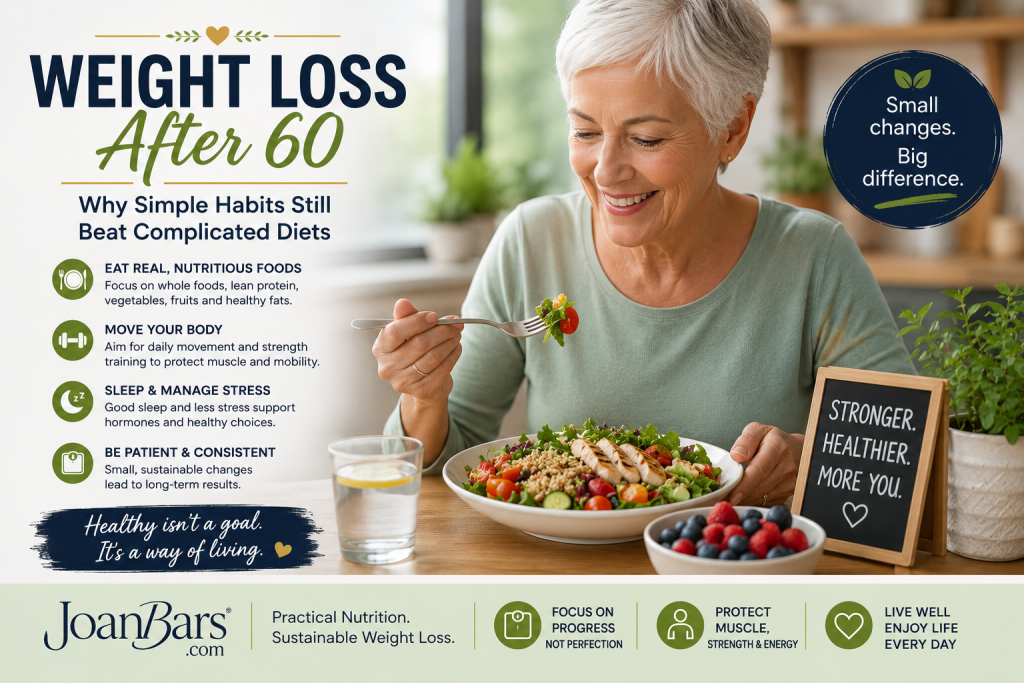
You need a pattern you can repeat.
Eat mostly nutritious foods.
Include enough protein.
Pay attention to portions.
Move every day.
Strengthen your muscles.
Get adequate sleep.
Enjoy occasional treats without turning them into week-long vacations from healthy eating.
And don’t expect overnight results.
The Saturday Morning Diet philosophy has always been built around making weight loss practical rather than turning it into another full-time job. You can explore more weight-loss and healthy-aging resources in the JoanBars article library.
Because the best weight-loss plan is not the plan that works spectacularly for 30 days.
It’s the one you can still live with a year from now.
After 60, don’t just try to lose weight. Build a way of eating and living that helps you stay strong enough to enjoy the weight you’ve lost — and the years you’ve gained.
This article is for educational purposes only and is not medical advice. Older adults, particularly those with chronic medical conditions or taking medications, should speak with their healthcare professional before beginning a significant weight-loss or exercise program.